
Campaigns & Strategy | Featured Piece
Digital Health Communication Campaign:
Boobs4Babies (Research Essay, Campaign Website, and Social Media Marketing Plan)


Spring 2025 | ComHlth 573: ‘Communication Health in Digital Landscape’
“Organic search drove more blog traffic than any social post, confirming that writing for real questions, not just posting for likes, was the right call.”
Background
This was a very involved, semester long project, that had three different components. The assignment asked students to develop and execute an original digital health communication campaign from the concept stages through live deployment of all assets, with three integrated deliverables submitted together: a research essay, a campaign website, and a social media marketing plan.
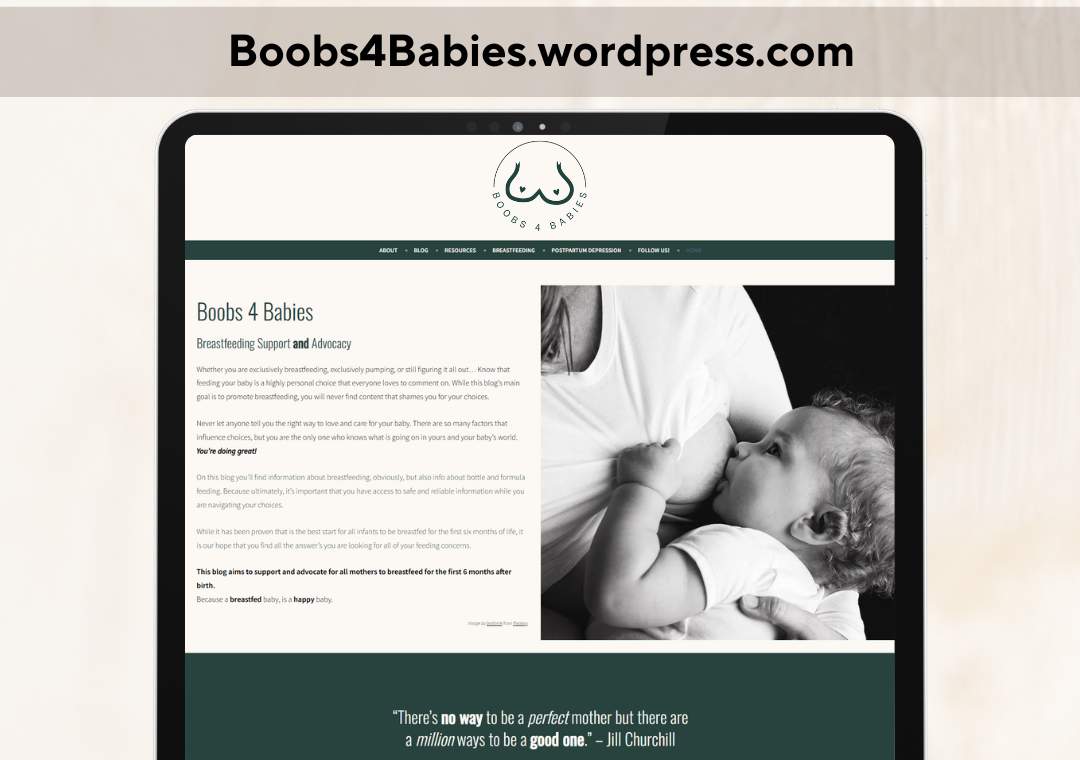
The campaign I built is called Boobs4Babies; a breastfeeding advocacy and infant feeding support platform centered on the core belief that every mother deserves judgment-free support, regardless of how she chooses to feed her baby. The campaign tagline I created was, “Because a fed baby is a happy baby,” and that really reflects the inclusive, non-prescriptive philosophy. It was important to me to not position breastfeeding as the only right choice, so the goal of the campaign was aimed to dismantle the stigma that mothers face across any and all feeding decisions they make, because let’s face it, moms are scrutinized no matter what they chose, be it exclusive breastfeeding, pumping, formula, or any combination of the three. Along with that, I wanted to provide evidence-based resources and peer community support as a ‘one-stop-shop’ resource for moms.
This project involved research and writing for the essay, website design and build in WordPress, content creation for social media in Canva Pro, scheduling and automation in SproutSocial, blog post writing, SEO optimization, and post-campaign analytics review with Google Analytics.
Scope
The scope of this project was beyond anything I’ve ever created before, but it was important to me that every single piece was a final product that would be deemed “portfolio worthy.” With that in mind, every little aspect of the project was completed to the fullest and with no shortcuts.
While each component was a complete project on its own; together they formed an integrated campaign ecosystem that had to function coherently across research, web, and social channels simultaneously.
Research Essay:
The research essay examined the evidence base for infant feeding stigma, the systemic and social barriers that prevent mothers from meeting their breastfeeding goals, and the role of digital health communication in providing accessible, non-judgmental support. It served as the academic and strategic foundation for the campaign, grounding the messaging in peer-reviewed scholarship.
Campaign Website:
The website was built in WordPress and went through two full draft iterations before the final version launched. The site architecture spanned multiple levels with top-level pages and sub-pages nested beneath several of them. Building and maintaining the multi-level structure required careful navigation planning to ensure users could find content without getting lost, and that search engines could index the full site hierarchy. It required designing a site architecture that balanced all of these content areas while maintaining a warm, accessible visual identity consistent with the campaign brand. Technical requirements included completing a 25-point website launch checklist covering SEO configuration (that also utilized the WordPress Plugins ‘Jetpack’ and ‘Yoast’), Google Analytics setup, browser compatibility testing across Chrome, Firefox, and Safari, mobile performance optimization (final score: 95), sitemap and site verification submission, privacy policy creation, spam protection, and Jetpack security and backup setup.
Key site features included estimated read times on blog posts, a Taplink link-in-bio page that connected Instagram and Twitter followers to all campaign resources, a newsletter subscription CTA embedded throughout the site, and a dropdown navigation structure that made the Blog and Resources sections independently discoverable.
Brand Identity:
Before a single post went live, the campaign required a full brand identity built from scratch. This included selecting a color theme, brainstorming the site name and taglines, designing the Boobs4Babies logo, creating custom headers for both Instagram and Twitter, and designing a complete set of Instagram highlight covers to organize the profile’s saved story categories. These assets had to be visually consistent with each other and with the website aesthetic, establishing a cohesive brand presence across every platform before the campaign launched.
Brand Mood Board:

Social Media Marketing Plan:
The social media component included a comprehensive written plan, a 24-page draft content calendar, and a fully executed live campaign that produced 66 individual pieces of content across Instagram and Twitter. Content types included static posts, multi-slide carousels, animated and static stories, and Reels. I chose to use SproutSocial to schedule all posts using platform-specific “Optimal Send Times,” with a coordinated blog post content calendar aligning WordPress publishing to the social channel promotion windows.
Process
Research Essay:
I began with a literature review of research about infant feeding stigma, breastfeeding barriers, and digital health communication best practices. The chosen research helped to ground every subsequent campaign decision, from the inclusive, non-judgmental tone of the website to the choice of Instagram as the primary engagement platform. The research consistently pointed to the importance of peer support, emotional validation, and accessible health information for new mothers that are navigating feeding decisions under social pressure.
Final Copy of the Research Paper:
Website Build:
There were two draft iterations of the website. The first version established the core structure and content that I wanted to include (like a resources section). The second draft was where substantial improvements were made: the domain was renamed to ‘boobs4babies’ to match the social handles for brand consistency; the navigation was restructured so that Blog Posts and Resources had their own dedicated landing pages within dropdown menus instead of being easily missed; estimated read times were added to every blog post; and the About page was humanized with a personal photo and a narrative about my own breastfeeding experiences with my three children.
Prior to the campaign launching on March 31st, I completed the full website launch checklist that included items like configuring SEO metadata (including a 158-character front page meta description), setting permalink structures to “day and name” format, verifying the site with Google Search Console, Bing, Pinterest, and Yandex, activating Jetpack Backup, and setting up 404 redirect handling. The site achieved a mobile performance score of 95.
Social Media and Blog Execution:
The social media plan was one of the biggest pieces of the project because it required careful planning and writing to not post at the wrong times or too often, and to not sound repetitive in post copy. After planning the content calendar, I was able to finalize all content pieces and schedule the campaign to run automatically by utilizing SproutSocial. Before the campaign launched, I also went back in and standardized all the CTA’s to every post and to coordinate the blog post calendar so that every social promotion post had a live blog article to link to. During the two-week campaign, I spent ten to fifteen minutes each day engaging with similar accounts on Instagram to organically boost visibility instead of passively waiting for the algorithm to spread my content.
One key decision was to use SproutSocial’s automation for posting instead of manually posting each piece at all different times across the two-week campaign schedule. This really helped me free up time and allowed me to focus on community engagement instead.
See the Completed Blog at: Boobs4Babies.wordpress.com/blog
Blog Posts:
- 5 Interesting Facts About Breastfeeding
- Campaign Assets Portfolio
- Let’s Talk Series: Breastfeeding
- Benefits of Breastfeeding
- Why Don’t Women Breastfeed for as Long as They Would Like?
- The Benefits of Having a Lactation Consultant
- Let’s Talk Series: Breastfeeding FAQ’s
- Breaking Down the Barriers to Breastfeeding
- Let’s Talk Series: Formula
- To Supplement with Formula or Not?
- My Favorite Products for Breastfeeding
52 of the 66 Pieces of Content that I Created:


Lessons Learned
What went well:
Instagram substantially exceeded my expectations across every measurable metric. The top-performing Reel earned 216 video views and a reach of 197 users. Engagement rates on tagged posts reached as high as 12.3%, which was well above typical benchmarks for the platform. The “Let’s Talk” series and Q&A carousel formats consistently outperformed static informational posts, confirming that content inviting participation resonated more than one-directional messaging.
SproutSocial proved to be the right operational choice for my campaign. Automating the posting schedule made the campaign logistically manageable while allowing daily time for genuine community interaction. I found that the people I was engaging with were more likely to engage with my content, so the time spent each day was worth the time.
The main challenge:
X (formally Twitter) was a challenge from the start. I couldn’t use other platforms because I couldn’t risk my client base seeing the campaign. X was a consistent underperformer in every single aspect of the campaign. Posts averaged just 2 in potential reach and generated zero link clicks or measurable interactions. The platform just didn’t support the kind of participatory, visually-driven engagement that the maternal health audience responded to on Instagram. This was not entirely surprising, but the gap was starker than I had anticipated and the finding reinforced that platform selection is not interchangeable when audience behavior is the variable.
Also worth noting is that the Instagram stories showed high exit rates with up to 9 exits per story in some cases as well as limited forward taps, which indicated format fatigue when stories lacked interactive elements. Likewise, static stories, without a clear engagement hook, did not hold attention. This was a learning moment for me about format design within the platform, not just the platform itself.
I also hypothesized that on the days where two posts were scheduled to go live, even though they were both scheduled at the 5-star optimal send time, it was too much at once and that likely created audience saturation instead of two distinct reach opportunities. In the future, it would be important to stagger the second post so that visibility is distributed across the day more effectively.
Outcomes:
After the campaign ran successfully for two weeks, the post-campaign analytics provided concrete, data-grounded comparison between social channels for maternal health audiences.
From a skill perspective, this project provided hands-on experience with the full lifecycle of a digital health communication campaign. The ability to compare planned strategy against actual analytics data, and then articulate what to do differently in the future, was one of the most practically transferable outcomes of the entire project.
Leave a Reply