
Ethics & Research | Featured Piece
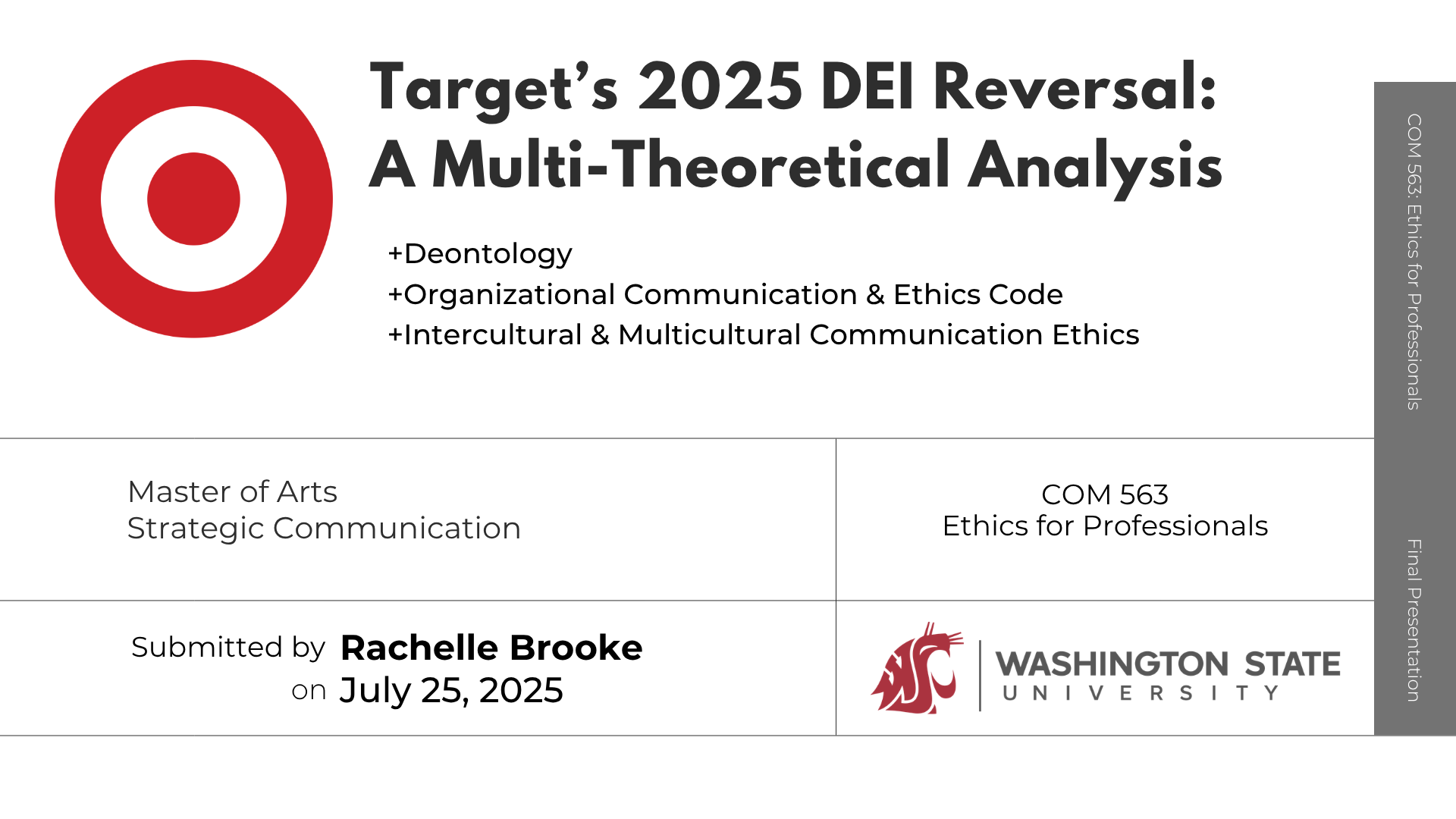
Target’s 2025 DEI Reversal:
A Multi-Theoretical Analysis


Summer 2025 | Com 563: ‘Ethics for Professionals’
“Ethical consistency isn’t just a moral virtue, it’s a strategic communication asset.”
Background
This piece was developed for COM 563: Ethics for Professionals. The assignment required selecting a real-world corporate ethical dilemma and analyzing it through a minimum of two formal ethical theories, along with a written outline, a recorded video presentation, and a personal reflection on which ethical framework best aligns with my own approach to professional ethics.
I chose to focus this project on Target’s January 2025 DEI reversal decision in which the company terminated its $2 billion DEI investment, ended the “REACH initiative,” and restructured its Supplier Diversity program. This focus allowed me to analyze the connected pieces of corporate ethics, stakeholder communication, and equity.
Not every ethical dilemma has a clear answer, but this one does. That clarity is exactly what made it the right case for demonstrating how multiple ethical frameworks arrive at the same conclusion through different reasoning.
I chose to feature this piece in my portfolio because it reflects the kind of analytical work I do well: rigorous, evidence-based, and willing to take a clear position when the framework supports one.
Scope
The project had two distinct deliverables: A detailed written outline following a defined structure, and a recorded video presentation with a full script.
The outline required analyzing three ethical frameworks across three potential choices Target could have made, evaluating whether each theory was reflected or violated, the positive and negative ramifications of each choice, and the real-world fallout and responses from those choices.
I focused this project on the following theories: Deontology, Organizational Communication Ethics Code, and Intercultural and Multicultural Communication Ethics.
What followed was a finished product that included an 80-slide, 12-source academic presentation with a full script.
Watch the Full Presentation with Audio at: Target’s 2025 DEI Reversal: A Multi-Theoretical Analysis
Process
I started with the ethical dilemma itself before selecting theories, because the case needed to drive the framework selection, and not the other way around. Target’s DEI rollback was an instance where deontological duties of justice and fidelity were clearly implicated, where formal ethics codes and organizational communication principles are directly violated, and where multicultural communication ethics added an interesting dimension that neither of the first two theories could fully captured on their own. Together, the three theories created a genuinely layered analysis of Target’s decision.
From there I built the written outline section by section from summary, theory application, choice analysis, reflection or violation, ramifications, and fallout; repeating that structure across all three theories to keep the analysis parallel and scannable. I also developed three discussion prompts designed to push the reader to analyze the ethical reasoning.
Lastly, the presentation script was written to follow the slide deck while also adding context and framing that the slides couldn’t carry on their own. This was especially true for the deontological theory section, where I spent time humanizing W.D. Ross’s framework for a general audience before applying it to the specific situation.
Lessons Learned
What went well:
What worked well was the decision to lead with the case and not the theories first. Starting from what events actually happened and comparing those to what Target’s stated commitments were, gave the analysis a concrete anchor that made the theoretical frameworks connect more directly to the real ethical stakes of the issue.
The main challenge:
The more interesting challenge was the reflection paper, which asked: which ethical theory best aligned with how I actually make decisions? The honest answer was that virtue ethics required me to articulate why I find utilitarianism inadequate for everyday moral life, not just as a philosophical preference but as a practical argument grounded in real human cognitive and emotional limits. That kind of first-person ethical reasoning is very different from academic analysis, and writing it required being willing to make a real claim and then defend that claim instead of playing it safe and staying neutral.
Outcomes:
This piece reinforced something I already believed; that ethical consistency isn’t just a moral virtue in the abstract, but it’s a strategic communication asset and Target’s case makes that argument with real data. Target’s eight-week decline in foot traffic, a consumer boycott, and long-term reputational damage were not hypothetical consequences; they were the real and measurable costs of Target abandoning their stated values under pressure.
Leave a Reply